Friday, December 11, 2009

Gary Loomis joins Temple Fork Outfitters

A while back the Drake was running a spoof notice of how the re-animated corpse of Ernest Hemmingway had joined the staff at TFO, and I read it and was amused as it at times appears that every industry "great" has joined the staff. TFO's list of notables in the fly fishing world seems to grow every time I turn around, running the gamut from Lefty Kreh, Bob Clouser, and Jim Teeny and now notable rod designer and builder Gary Loomis is going to have significant impact on a line of spinning rods that TFO is introducing.

As one who owns several TFO products I have been pleased with the value of the product, and their great customer service. I look forward to seeing Gary's input on their product lines.

(Researching this a little further... I guess this is somewhat old news, but it was new to me ;) )

Wednesday, December 9, 2009

Cutthroats on the South Fork

I have heard from two sources now, but have not seen an official report yet that the cutthroat numbers on the South Fork are down and that the rainbow numbers are up. Both sources have noted that recent electro surveys around Conant have resulted in an increased presence of rainbows in that stretch.

I fish the stretch from Irwin down to Spring Creek or Conant more than any other stretch of the river and in the last couple of years my non-empirical methods of just counting what I am catching had me catching cutthroats at a rate of about 7:1 to rainbows, and the number of rainbows I have been catching was decreasing yearly. My methods must have produced bad results as the electro shocking is showing otherwise (cutthroat have always been a bit easier to fool on a fly).

Anglers, if you fish the SF please keep all the rainbows you catch. Give them to friends, neighbors and colleagues, but don't just release them back into the river.

Tuesday, December 8, 2009

Fate of the Teton River and it's wild cutthroat

As a native of SE Idaho with the Teton River some 20 minutes from my house I have watched with a mixture of fascination and disgust as every year local state legislators and water companies try to introduce legislation to rebuild the dam. The dam that failed 30 some odd years ago, catastrophically. Strangely enough they want to build a new dam in the same geologically fractured area as the original dam, which seems to me a bad idea. Especially as my house sits in an area that could possibly be inundated if the dam was to fail again.............. a secondary concern to what the dam would do to one of the best cutthroat fisheries in the nation.

There is a good article at The Cleanest Line on the Teton. Go check it out. And a good TU Video.

Thursday, December 3, 2009

Whirling Disease White Paper

The University of Montana together with Trout Unlimited have published a Whirling Disease White Paper detailing research into the life cycle and management of whirling disease/ check it out at http://whirlingdisease.montana.edu/resources/publications.htm . Other resources are also available at the site.

Update: Not only are other resources available they are in the form of two free videos. One on whirling disease, "Black Tale" and the other on cutthroat trout: "Rising From the Shadows." The videos are free and they don't even charge for shipping. I should have mine shortly.

Wednesday, December 2, 2009

We now return to our regularly scheduled programming

So steelhead season for me is mostly over. I will still spend some time tying steelhead flies and from time to time will post pictures of the flies, but for the most part I am returning to news on non anadromous fish.

From The Cutthroat's Spot


As cutthroats are one of my favorite fish, the namesake of the site, and the species I most often fish for I am going to try to cover more cutthroat specific topics the next little while. I spent most of the late summer and fall chasing native snake river and fine spotted cutthroat in SF tributaries. I am going to try to branch out to more species the coming year as I know of some creeks north of here full of west slope cutts.

Speaking of other cutthroat species, the Center for Biological Diversity has filed a lawsuit seeking protection for threatened Colorado Cutthroat. Their suit makes the argument that the colorado Cutthroat was not listed because it is doing fairly well in it's current range, but that the historic range was not considered (size of historic range) in the decision making process. The questions then becomes would federal management of this species have better results than what is currently being accomplished by state by state management (mostly in Utah and Colorado)?

Most of the discussion from anglers and conservation groups that I am aware of considers state management a better option, but feel free to disagree and to discuss.

Wednesday, November 25, 2009

Learning about steelhead flies.

As I get deeper into this steelhead obsession I am learning more about constructing steelhead flies. The internet is full of information, most of it pretty good about steelhead flies. One of the points most sites have made is that more steelhead are caught on a hook covered with a piece of yarn than just about anything else and so when it comes to flies steelhead are not too picky. Presentation and getting the fly in front of the fish are the most important factors.


(I am not the best macro photographer in the world. A tripod would likely help.)

But when it comes to flies for steelhead:

1: Use the right material for the current. Stiffer less likely to collapse materials for heavy current and softer materials for soft slow currents. So kip tail, spun hair, stiffer hackles and such for the fast water and marabou and bunny strips for the soft water.

2: Have the sharpest hook possible. I read a few bits on filing a hook with a mill file, watched a couple of online demos and broke out the file. Tapering the hook point so that is a long gradual transition makes a hook that will better penetrate a steelhead's mouth. Though modern hooks are fairly sharp increasing the transition length so that the transition is "smoother" with a file (at least in my no scientific tests) does make the hook penetrate easier. I will start carrying a file with me. This also allows for on stream hook repairs.

3: Hook eye. For steelhead on the swing and dead drifted it seem a straight eye is probably best. With the hooks I am using for my shank flies I am tying a type of "egg keeper" knot. Basically I run the line through the eye, make a loop and pinch it with my finger and then whip four - five time around the shank. This way the line come straight off of the shank and through the eye, inline with the shank and is not actually tied to the eye. When I run out of these hooks I will get some straight eye hooks. Another trick is to cut off the eye and tie in an eye with mono or somesuch.

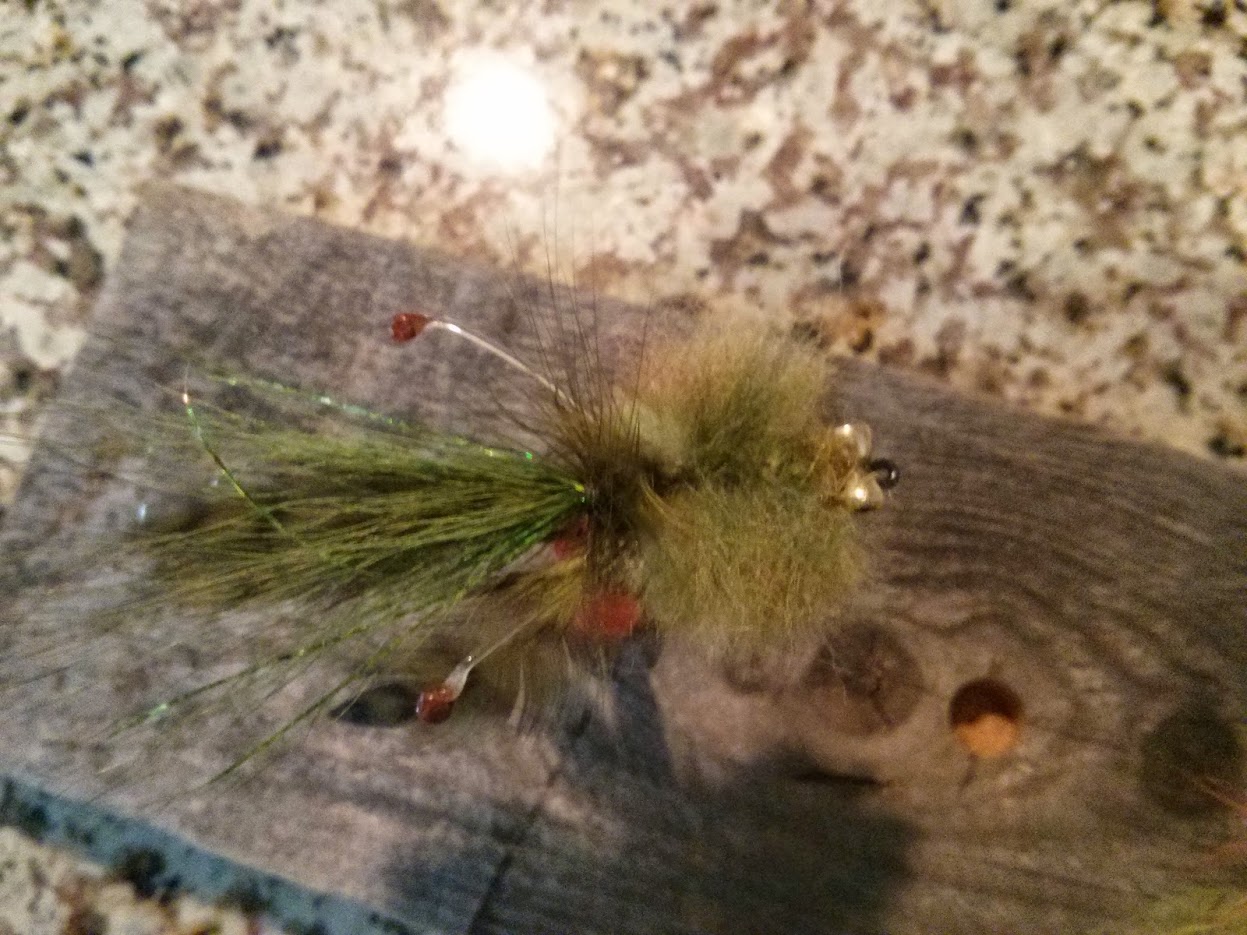
Orange fast water fly.


4:Color. Many guides say fish any color that you like....... as long as it is purple. I am still playing with lots of colors, but am tying some purple. I also am playing with orange as it is supposed to work well. My tying supplies are somewhat limited, but white hackles and sharpies can create a range of colors. All the hackles on these flies have been colored with a sharpie.

Purple fly with stiff materials for heavy water.

I am tying more flies for heavier water. This is due to the fact that I find myself fishing the tops and bottoms of rapids more than anything when I am on the Salmon. "Resting water", due to the fact that the "holding" water has been shoulder to shoulder spinning guys...... not very easy to fish with the crowds on a fly rod, so I head for the uncrowded spots.

These flies are tied:
Orange fly has some flash behind the tail collar.
Dry hackle collar tail.
Floss body
Chenille Body
Light silver wire over body
Colored turkey flat under wing (the stiff hackles not the webby part)
Large dry fly hackle collar
Hen hackle topping wing
Hen hackle collar
The purple one also has some peacock herls in front of the hen hackle collar.

Monday, November 23, 2009

Last Steelhead trip of the Season?

I have decided that I really like tying steelhead flies. Even though I am not very quick at it. Each fly takes me over 20 minutes and so I do good to get 2-3 out a night.


Flies I tied for this trip.

I have been following Mike D's blog and he had a post about tying on waddington shanks. They looked pretty nifty but no one in my area carried them and they were pricey. A bit of internet searching revealed that some people tie shank flies by making their own shanks out of cotter pins. So I bought 100 each of 1/16 X 1" and 1/16 X 1.5" steel cotter pins. I built a "mandrel" out of a piece of wood and a finishing nail and made my own shanks. The flies turned out pretty nice. I attached the Gamakatsu hooks using some small yellow silicone tubing purchased at a small engine repair shop. I am thrifty. ;)

I am now contemplating making some Christmas ornaments out of steelhead flies put into clear acrylic balls.


Home made shanks and mandrel


I tied about a dozen flies in preparation of my last trip up to Salmon. I awoke at just before 5:00 am and drove up. The weather has turned colder and water temps have dropped about 10 degrees or there abouts. Now I am not a steelhead expert but I think the cooler water equates into less active fish. I fished for about 8 hours and had one on for a few seconds but it was slower than my last rip where I had 3 on and I didn't even catch a sucker fish. The skunk is on me. As the temps continue to drop I think I am done till spring (steelheading that is, I will still be out on the river casting midges and nymphs on the SF)....... Unless some one can convince me otherwise.


Two shank flies on the 1.5" shanks


Another perspective


Still the country up there is gorgeous and I enjoyed the trip. I will head up again (hopefully somewhere between Challis and Stanley) when the ice starts to melt.

Steelhead Country


I switched form my 9' 8wt Rivendell rod to a 10' 8wt G Loomis glx and have liked the change. But after watching the guys with spey rods roll out 80 foot roll casts where I have to work hard for 30 feet, well I am contemplating selling all of my single hand overhead 8wt gear and getting an Echo 7 or 8wt spey set up. On the Salmon where you are often fishing with the bank right behind you back casting is impossible a majority of the time and roll casting becomes key. I was making 40-50 foot casts with back casting in a couple of spots but casting 2 heavy tungsten bead flies on my 8wt seems harder than casting a pair of much smaller nymphs on my 5wt or even a set of big dries like a salmon fly and a golden stone on my 5wt. I was using a fairly long leader to allow the flies to get some depth and dead drifting them nymph style. I don't know if the casting difficulties were my own lack of experience with the 8wt, the way the leader was constructed or what exactly but I can not cast as far with the 8wt as I can with my 5wt. Between that and the omnipresent bank at my back I am really starting to lean towards purchasing a spey outfit.